

23 Apr What the battery market is telling us: five signals from the field
What the Battery Market is Telling us: Five Signals from the Field
23 April 2026
The Regulation (EU) 2023/1542 on batteries and waste batteries (EU Battery Regulation, EUBR) has been in force since the summer of 2023. For much of that period, the market stayed in a monitoring phase. However, the pattern we are now observing is beginning to shift.
Across our testing and certification teams, several consistent patterns have emerged over recent months. Taken together, these indicate a market shifting from regulatory awareness to structured compliance action, and to a broader shift in how manufactures are engaging independent technical partners.
The question has changed from ‘do we comply’ to ‘can we prove it’
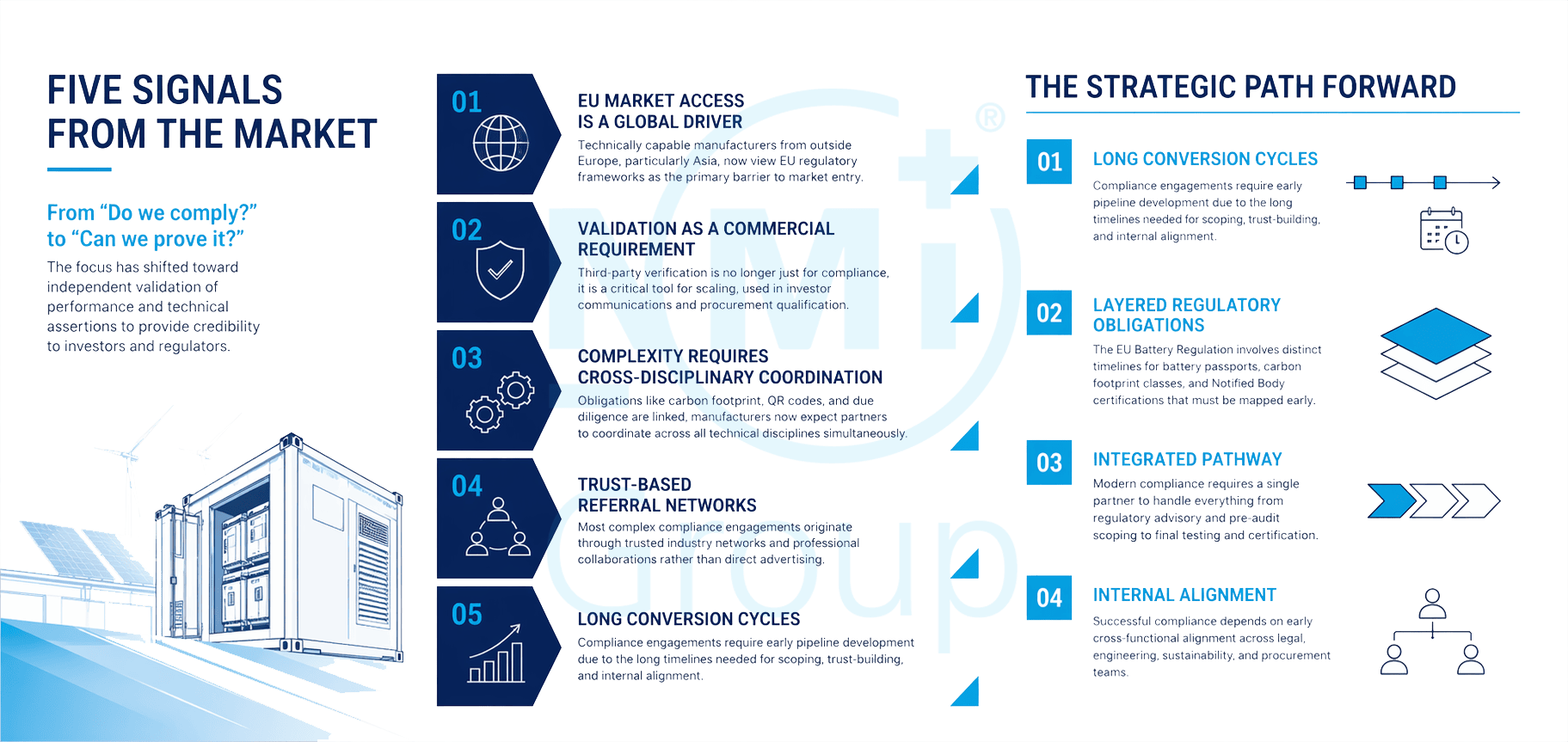
The focus has shifted. Manufacturers are no longer asking only whether their products meet regulatory requirements. They are seeking independent validation of performance declarations, process outcomes, and technical assertions — in a form that holds up with customers, investors, and regulators alike.
This is particularly evident in projects linked to the EU Battery Regulation, where technical validation and regulatory interpretation are converging. Manufacturers are seeking partners who understand both, not as separate services, but as an integrated capability.
EU market access is driving engagement from outside Europe
A growing proportion of active discussions originates from manufacturers outside Europe, particularly in Asia, seeking structured pathways into EU markets. These are technically capable organisations for whom EU regulatory frameworks, including the Battery Regulation and CE marking requirements, are now the primary barrier to market access.
What these organisations require is not testing in isolation, but a partner who can combine technical validation with clear regulatory interpretation, and who understands the full pathway from initial assessment through to EU market clearance.
Independent validation is becoming a commercial requirement, not just a regulatory one
A distinct trend is the growing role of independent verification in commercial contexts beyond regulatory compliance. Manufacturers are presenting battery performance data, process validation results, and cell or electrode technology claims to customers and investors as evidence of product credibility. For emerging battery technology companies, third-party validation is becoming a prerequisite for scaling — one that investors and strategic partners increasingly expect.
The audience for technical validation has expanded. Compliance teams remain central, but testing and certification outputs are now used in investor communications, procurement qualification, and partner due diligence — in some cases as the primary commercial differentiator.
Regulatory complexity is increasing and cross-disciplinary coordination has become the expectation
Battery removability and replaceability requirements, QR code and traceability obligations, transport testing, due diligence, and carbon footprint declarations do not operate independently, they are technically and procedurally linked. Manufacturers addressing them in sequence, through separate providers, create duplication and gaps. The expectation has shifted toward partners who can coordinate across disciplines within a single engagement.
Network and collaboration are the primary routes into new engagements
A notable proportion of active project discussions originate through collaboration with other laboratories, certification bodies, and industry networks. Manufacturers seeking complex, multi-disciplinary support tend to start with a trusted referral. Credibility in this market is built through visible expertise and peer relationships over time, not advertising.
The conversion timeline is also worth noting. Discussions from industry events and professional networks, including Battery Day NL last year, are now progressing into structured testing and certification scopes. The cycle is long by design: compliance engagements require trust, precise scoping, and internal alignment. That predictability makes early pipeline development more important, not less.
What this means for manufacturers
The EUBR is not a single compliance event. It is a layered set of obligations: battery passports, carbon footprint classes, due diligence, and Notified Body certification, each with distinct timelines and dependencies. Manufacturers making the most progress are those who have mapped those dependencies early and engaged technical and regulatory partners before deadline pressure arrives.
NMi Certin has formally applied for Notified Body designation under EUBR 2023/1542. Together with TESTLAB’s testing capability, we offer an integrated pathway across the compliance lifecycle — from regulatory advisory and pre-audit scoping through to testing and certification.

Want to know more?
Sign up for our EUBR Webinar Series
